
The Hard Four ⚁ ⚁
The four hardest lessons that changed my odds


The probability of rolling a hard four is 1 in 9. The true odds are 8 to 1. When you place money on this bet, the house edge is 11.11%. If each die lands on a two, your money pays out eight times your stake. Any combination of seven, or a three and a one, and you end up with zero. The odds are stacked against you in a meaningful way, and you’re highly likely to lose, to the tune of an 88.89% chance. Savvy gamblers will try to shift those odds ever so slightly in their favor by rolling the dice the exact same way every time. Over the course of many rolls, they believe they can marginally improve the math.
But no matter how you slice it, the odds are heavily in favor of the house.
Placing a bet that two identical numbers hit…a three and a three, a four and a four, and so on…is known as betting the “hard ways.” Professional gamblers often refer to these bets as sucker bets because of their high house edge.
On their own, hard way bets truly are sucker bets. The house edge is brutal.
But if you combine them with a pass line bet and take odds behind the pass, something interesting happens. Your overall odds improve dramatically. The bet is still risky, but you’ve shifted the math. Throughout my life, there have been pivotal moments where the odds of certain outcomes shifted significantly in a single direction. Some were bad decisions that made the odds longer, while others improved them. In the end, I’ve realized that life can really be chalked up to a series of rolls.
At the craps table, each bet in isolation has the same odds every time the dice are thrown. In life, the table is far more complex.
Life, I’ve found, works in much the same way. The odds are rarely good. Sometimes they’re terrible. But every once in a while you encounter a decision, a habit, or a lesson that shifts the math just enough in your favor.
The longer you stay at the table, the more rolls you get.
I turn forty-two this week. Which means I’ve had forty-two years of rolls to learn a few hard ways.
These are mine.
Hard Way #1: Teams and Families Are Not the Same
Age 10
Vegas line on making it to college: ~5% (about 1 in 20)
“We're a sports team, and we're trying to win the Super Bowl. And so we're going to put the best players on the field we can. And if you go down the field, and we throw you the ball, and you drop it a bunch, we're going to cut you. Because everybody else who's trying hard to win the game deserves to have the best players on the field. And if you're a good player, you're going to love being on this team.” -Barry McCarthy, Former CEO of Peloton
On the night of April 19, 1994, the odds of my future changed dramatically. My father was paralyzed from the chest down in a car accident that nearly took his life. The ripple effects were immediate and long-lasting. My family entered a period of hardship and uncertainty, though I didn’t fully understand at the time how much the odds had shifted.
Like many kids navigating a chaotic home environment, I found refuge in sports.
Sports offered structure, accountability, and competition. It also brought me closer to a neighborhood friend who would eventually lead me to one of the most important experiences of my childhood: Culver Summer Schools.
I was fortunate enough to attend on a full hardship scholarship. When I arrived, I quickly realized why I needed that scholarship. Many of the other campers came from backgrounds that couldn’t have been more different from mine.
But sports have a way of leveling the playing field.
On a team, it doesn’t matter where you come from. What matters is whether you can contribute. That’s where I first began to understand something that would become one of the harder lessons of my career: teams and families are not the same thing.
Families are unconditional. Teams are not.
On a team, performance matters. If the ball comes your way and you keep dropping it, eventually someone else gets your spot.
It took me years to fully connect the dots professionally.
Early in my career, I often described the company I helped build as the Upper Hand family. I believed it at the time. But after I left, the reality became clear almost immediately. The outreach stopped. Most of the staff moved on and even many of the investors disappeared from my circle. At first, I was offended, but eventually I came around to understanding the table that we had been playing at: this was a team, and not a family.
Companies have incentives, employees have incentives, and when those incentives stop aligning, things change.
Once you recognize that dynamic, you begin to approach work differently. You show up to contribute, you play your role on the team, and you understand the game being played. When the team wins, everyone benefits. When it doesn’t, the roster changes. That realization shifted the math for me. Of course, shifting the math doesn’t guarantee that the odds are now good, which brings me to the next hard way…
Hard Way #2: Build When the Odds Are Bad
Age 18
Vegas line on graduating from the Kelley School of Business with a finance degree: ~1% (about 1 in 100)
Coming out of my first semester at IU, I was staring down the barrel of the gun. I had gotten into trouble in the dorms, resulting in a one-year suspension, and closed out the semester with a whopping 1.7 GPA.
The odds of getting into the highly competitive Kelley School of Business were long before, but now they were abysmal.
When I returned to IU, I knew I had significant catching up to do. I buried my head in books, but I was also desperate to find a way to differentiate myself in the eyes of admissions.
Through a class called X220, I was exposed to many opportunities to get involved, but most of them felt like people trying to check resume boxes rather than build something meaningful.
That changed when I walked into a call-out meeting and met a student named Kevin MacCauley.
Together, with an incredible group of students and a key advisor, Dr. Cynthia Rex, we built the first ever collegiate-hosted half marathon in the country and established the largest scholarship for cancer survivors in the world.
And just like that, the odds were closer to even.
The experience was formative. I had seen my dad beat the odds by building a business after his accident, but this was the first time I had done it myself.
The confidence and empowerment it gave me changed the trajectory of my life, eventually leading to Upper Hand and a realization that has stayed with me ever since: when the odds are bad, build something that changes them.
This is not a new phenomenon, and is often how entrepreneurship works. When the odds are good, most people play it safe. When the odds are bad, more people decide to build something instead. It makes sense. When things are uncertain, society becomes insular. There are fewer people reaching out to lend a hand, because they don’t feel confident in being able to help themselves.
It’s in these times of adversity and economic uncertainty, where true builders are inspired to take control of their situations by focusing on what they can do: build. While I didn’t see it clearly during this time, I also finally began understanding during times like these that no one cares about you as much as you think they do. That realization would become Hard Way #3.
Hard Way #3: No One is Watching
Age 23
Vegas line on building a venture-backed company: ~0.5% (about 1 in 200)
On August 12, 2012, I quit a job I really enjoyed and left behind a team that I loved. The reason was to go start a software company with Kevin. I was right at the corner of terrified and excited, and honestly I let the terrified piece of that keep me from making the leap sooner. I’ve spent most of my life caring way too much what people think, because I thought they cared what I had to say or do way more than they actually did. This fear of judgement and the false high from egotistical reflection were crippling for me in my 20s and 30s as we built Upper Hand.
These were the longest odds that I had ever faced (and I had faced some long odds!), and for reasons I could not explain at the time, I decided to make make these odds even worse. Eventually I learned that it is very common for young adults to exhibit relatively outsized egos as they transition from adolescence to adulthood. This is largely due to insecurities associated with individuals trying to establish themselves in this new “world”. I think these insecurities were magnified for me, causing me to care about and act out more than most.
When you’ve spent most of your life feeling like you have no business being in the room, it has a profound impact on your identity, and as a result, who you feel as a person to the outside world. It wasn’t until the past ~6 years that I finally came to the realization that no one cares. If you get up on stage and fumble, most people aren’t going to notice. Your post on LinkedIn? If you care deeply about it, the chances are no one else really does, regardless of how many “likes” it gets. While it sounds negative, it’s actually extremely liberating.
If you want to tilt the odds in your favor, stop staring in the mirror, stop performing for the crowd, and start living for something bigger than yourself. You don’t matter as much as you think, and that’s truly a beautiful thing. The hardest part is admitting it, and living by it relentlessly. It took me years to realize that the easiest way to do that is to search for meaning somewhere deeper. Hard way #4…
Hard Way #4: Your Environment Eventually Wins
Age 30
Vegas line on attaining the lifestyle we have today: ~3% (about 1 in 33)
I spent my 30s unwinding accumulated debt. This wasn’t financial debt, but internal debts that I had ignored for a very long time. Throughout this unwinding process, I learned something fundamental: if you don’t intentionally shape your environment, it will eventually shape you.
In my last piece, Optimizing Time, I discussed the concept of compounding beyond money as one of the five enduring principles I’ve learned over the years. The idea is simple: the same forces that compound wealth also compound the habits, behaviors, and environments that shape our lives.
This was the equation I eventually came to understand:
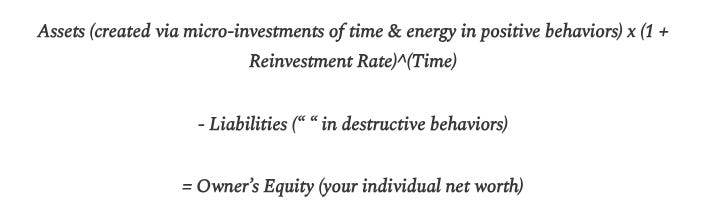
That liabilities line matters more than most people realize which I learned the hard way.
For most of my life I was obsessed with financial net worth, but it wasn’t until my late 30s that I realized how many internal liabilities I had been quietly accumulating. The silver lining is that I caught it before it was too late. This became the decade where I finally began paying those liabilities down and started seeing the table more clearly.
High achievers often tie their identity to performance. When the scoreboard looks good, they feel good. When it doesn’t, they don’t. For many people, especially those raised in low-odds environments, that system begins as a survival mechanism. Over time, the engine can become so powerful that it burns the person running it.
My own reset began with meditation and intentional self-reflection, and eventually led my family and me back to the Catholic Church. Along the way I shed a number of habits and vices, and I’ve now gone the longest stretch of my life without alcohol. Will I ever drink again? I honestly have no idea. Maybe, maybe not. But right now, it’s been great for me, my family, friends and co-workers.
As my internal environment began to change, my external environment slowly followed. Certain friendships that once revolved around old habits faded away, and new ones emerged that were built around shared values instead. Somewhere along the way I found a level of internal peace that I didn’t know was possible. And with that peace, the odds began tilting in ways that actually mattered.
Conclusion
If you’re still reading this, kudos. Based on my calculations, given the heavy internal reflection a piece like this likely requires, Vegas odds would probably place you somewhere around 25% (about 1 in 4) of making it all the way through.
Similarly, most people who step up to a craps table are unlikely to walk away with more money than they approached it with. Many will place a few bets, hit a seven after a handful of rolls, and leave the table. Some people, though…a special few…approach the table differently. They place their bets in ways that slowly and deliberately alter the probability of success. They watch the dice hit seven time and time again, but keep churning, adjusting, and finding ways to improve their odds.
Those people are rare.
As a society, and from where I stand personally today, we appear to be approaching a similar moment. The years ahead will present significant challenges for many people. If you’re working a white-collar job today, the odds of doing that same work in the same way five years from now are slim to none. The odds may be stacked against us right now, but the last thing we can do is stop rolling.
The hard ways rarely win at the craps table.
But in life, they’re often the bets that have the power to change everything. Keep rolling…